A car seat parked by the front door, one sock missing, head tipped sideways at an angle no adult neck could survive. Nobody photographs that. Then the seat gets sold, the hallway gets repainted, and the picture that would have brought the whole year back never existed.
Everyday baby photos are the ones that go missing. Parents shoot the birthday, the first steps, the holidays. The ordinary scaffolding of daily life goes unrecorded because it feels permanent while you are inside it. It is not.
Which everyday baby photos do parents wish they had?
Bath time
Wet hair standing straight up, a wrinkled expression of pure suspicion. Shoot from directly above with your phone in one hand, keeping the other on the baby, and get in close so the frame is mostly face and water. Wipe the lens first; steam fogs it in seconds.
The car seat
Both versions matter. Asleep with the straps at their smallest setting, and the seat sitting empty by the door with a blanket still in it. Crouch to seat height rather than shooting down from standing.
Mealtime disaster
Sweet potato in the eyebrows, a fistful of pasta, the tray as a canvas. Stand back far enough to include the high chair and the floor, because the aftermath is the story. Burst mode, then pick one.
The details you forget fastest
Being carried
Hip, shoulder, sling, forearm. Every parent has a default hold and none of us can describe our own. Ask someone else to take this one, or catch your partner doing it from across the room.
The nursery exactly as it is
Not tidied. The half-folded muslins, the monitor cable, the toy currently in favor. Stand in the doorway and take one wide frame each season. In four years this room will look nothing like this, and no memory will preserve the details.
Hands on your shoulder
The moment a baby is held upright against your chest, their hands do something specific: gripping fabric, patting, splayed flat. Photograph over your own shoulder in a mirror, or hand the phone across.
How do you catch these moments without planning?
Sleeping somewhere ridiculous
Face down in the play mat, jackknifed in the bouncer, out cold mid-bottle. These are safe-to-photograph accidents of the day, and they are the frames that make people laugh out loud years later. Take the picture, then move them, because the American Academy of Pediatrics advises moving a baby who has fallen asleep in a bouncer or car seat onto a firm, flat surface, on their back, for the rest of the sleep.
| Moment | Why you will miss it | Fastest way to get it |
|---|---|---|
| Bath time | Ends the day they can sit unaided | Overhead, close, one hand on the baby |
| Car seat | Outgrown within months | Crouch to seat height, include the straps |
| Mealtime mess | Skills improve fast | Stand back, burst, keep one |
| Being carried | Stops the week they walk | Hand the phone to someone else |
| The nursery | Redecorated and forgotten | One wide frame from the doorway, untidied |
| Sleeping oddly | Naps disappear entirely | Phone already in hand, no flash |
What habit makes everyday baby photos happen?
One photo a day, no standards. That is the whole system. Not a good photo, not a planned photo, just one frame of whatever this day looked like. Blurry counts. Badly lit counts. The bar has to be low enough that you clear it while exhausted, otherwise it lasts nine days.
Attach it to something you already do so it survives the fog of the first months. Before the evening feed, after the bath, whenever. Thirty seconds, no thinking. The value is not in any individual frame but in the run of them, which becomes a record of change so gradual it is invisible while it is happening, the kind that only shows itself when a photo from March lands next to a photo from June and the difference reads as a different child.
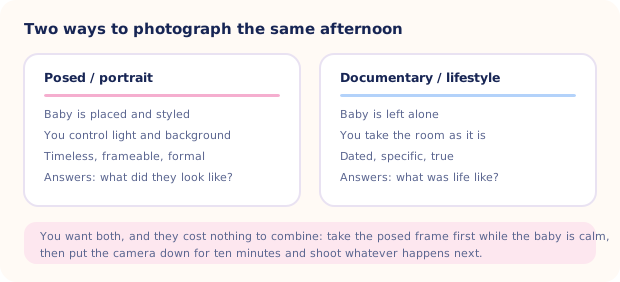
This is documentary shooting, applied on a schedule. The chart below sets it next to the posed approach, and the everyday habit lives squarely in the right-hand column: nothing arranged, nothing cleared, the room taken as it is.
If the approach appeals, our post on documentary baby photography goes further into technique, and organizing baby photos covers what to do once you have four thousand of them.
The scale trick
Photos lose scale almost immediately. Without a reference, a newborn hand looks like a hand. Put something familiar beside it and the size becomes shocking.
- Your hand next to theirs. Palm up, side by side, fingers not overlapping so both are readable. The single most repeatable scale photo there is.
- Their whole foot against your palm. Works even better than the hand version in the first weeks.
- A wedding ring on a toe or a wrist. Cliché for a reason, and it takes ten seconds (a wrist, realistically, past about week six).
- The same chair, every month. An armchair, a rocker, a specific corner of the sofa. The chair stays fixed while the baby fills more of it, which does the measuring for you.
Repeat any of these on the same day each month and the growth record builds itself, without anything being bought. The structured version of the same idea sits in our monthly baby picture ideas.
Photograph the things that annoy you. The sterilizer taking over the counter, the stroller in the hallway, the bottle drying rack. Irritation is a reliable signal that something is specific to this exact season of your life.
Which two rules keep the habit alive?
- Never delete on the day. Tired judgment is bad judgment, and the frames that feel throwaway now often age best. Cull months later, if at all.
- Do not wait for good light. Waiting is how the photo never gets taken. Turn the flash off, hold still, accept the grain, and move on with your evening.
If you do want to improve the odds on light without adding effort, shooting during the naturally bright hours helps, and the best time of day for baby photos explains which those are.
Both rules exist because the habit dies from judgment rather than from lack of time. The parents who keep going are the ones who stopped assessing each photo as a photograph and started treating it as a date stamp on an ordinary day.
Turning an ordinary frame into something wall-worthy
Occasionally one of these everyday shots turns out to be a genuinely great photograph of your baby's face, undermined only by the kitchen behind it. That is a solvable problem now. Totti takes one clear photo and regenerates the background, outfit, styling and lighting into a studio-style portrait, keeping your baby's real facial features exactly as they are. It also builds milestone cards, so a Tuesday snapshot can become a weekly or monthly card without a photoshoot ever being scheduled. Our baby milestone photos guide covers that side in detail.

Your best ordinary photo, restyled
50+ templates, milestone cards with wooden plaques, frames including Polaroid and Vintage, and HD export at 2048×2560. Free to download on iPhone and iPad, and it keeps a per-baby photo history as you go.
Get Totti on the App StoreStart tonight with the least remarkable thing in the house. The bath, the car seat, the corner of the room where they sleep. In two years none of it will exist in the same form, and you will be very glad one blurry photo of it does.